Property Identity Infrastructure

Every home deserves
a verified identity.

MyHOME ID is the persistent digital identity layer for residential property. It lives with the home — not the owner, not the agent, not the bank. Across every sale. Every transition. Every generation of devices.

135M+
Addresses Instantiated
~4,000
Device Fingerprints
211
Vendor Ecosystems
Day 1
Grid Was Already On
Scroll
The gap is architectural, not operational.

Connected fixtures — smart locks, thermostats, cameras, HVAC controllers, security systems — persist with the property across ownership cycles. Credential continuity does not.

No MLS field documents this. No title report captures it. No inspection protocol standardizes it. Every industry that touches a residential property transaction maintains its own fragmented record of what's inside. They don't talk to each other. They're not referencing the same source of truth.

The result: devices stay bound to prior owners. New owners inherit ghost accounts. Agents spend uncompensated time resolving it. The transaction closes without a record.

When a home with smart devices sells, the Nest thermostat is still in the old owner's Google account. The smart lock still has their fingerprint. The video doorbell may still be streaming to their phone. Nobody checked. There was no system for it. We call these Ghost Devices.

Asset Identity Standard Exists
Vehicle VIN
Business entity EIN
Financial security CUSIP
Real property (deed) Title / APN
Person SSN / passport
Home's digital infrastructure
MyHOME ID MYHID

Identity exists before the scan.
Not derived from it.

This is the core architectural inversion. Every U.S. residential address has already been assigned a persistent MyHOME ID — before any documentation event occurs. The identity is pre-instantiated, not generated on demand.

01 — Instantiate

The identity already exists.

135M+ U.S. residential addresses are pre-instantiated inside the MyHOME ID registry. Four regional Merkle roots, IPFS-pinned and anchored on Ethereum before any capture event. The grid was on before you arrived.

Pre-launch
02 — Document

Seller authorizes. System captures.

When a property owner initiates documentation, SL8 Sentinel identifies and fingerprints every connected fixture present. Participant-authorized. Snapshot-based. Not continuous. A submission produces a record; absence produces nothing.

Snapshot only
03 — Transfer

The record follows the property.

At closing, the verified profile transfers with the home — not the owner. Every device's transfer procedure is generated automatically. New owner, same identity. No ghost accounts. No orphaned access. No disputes.

Persistent

Five layers.
One infrastructure.

MyHOME ID is not a product. It is the reference layer that every other system eventually connects to — the way routing numbers connect to finance, or IP addresses connect to the internet.

The network effect is every enterprise partner that adopts MyHOME ID as their reference ID. One integration each, instead of bilateral integrations with every other participant. N to 1, not N squared.

Utility patent-pending verification architecture
01
MyHOME ID Registry
135M+ pre-instantiated property identities · Polygon-anchored
Live
02
SL8 Sentinel
AI documentation engine · 4,000 device fingerprints · 211 ecosystems
Live
03
SL8 Audit
Verified property profile · participant-authorized · PDF delivery
Beta
04
SL8 Access Point
Hardware capture device · WiFi + BLE · purpose-built v1 in progress
Beta
05
KODA
Ecosystem coordination asset · Reg S presale · Polygon · deflationary
Presale

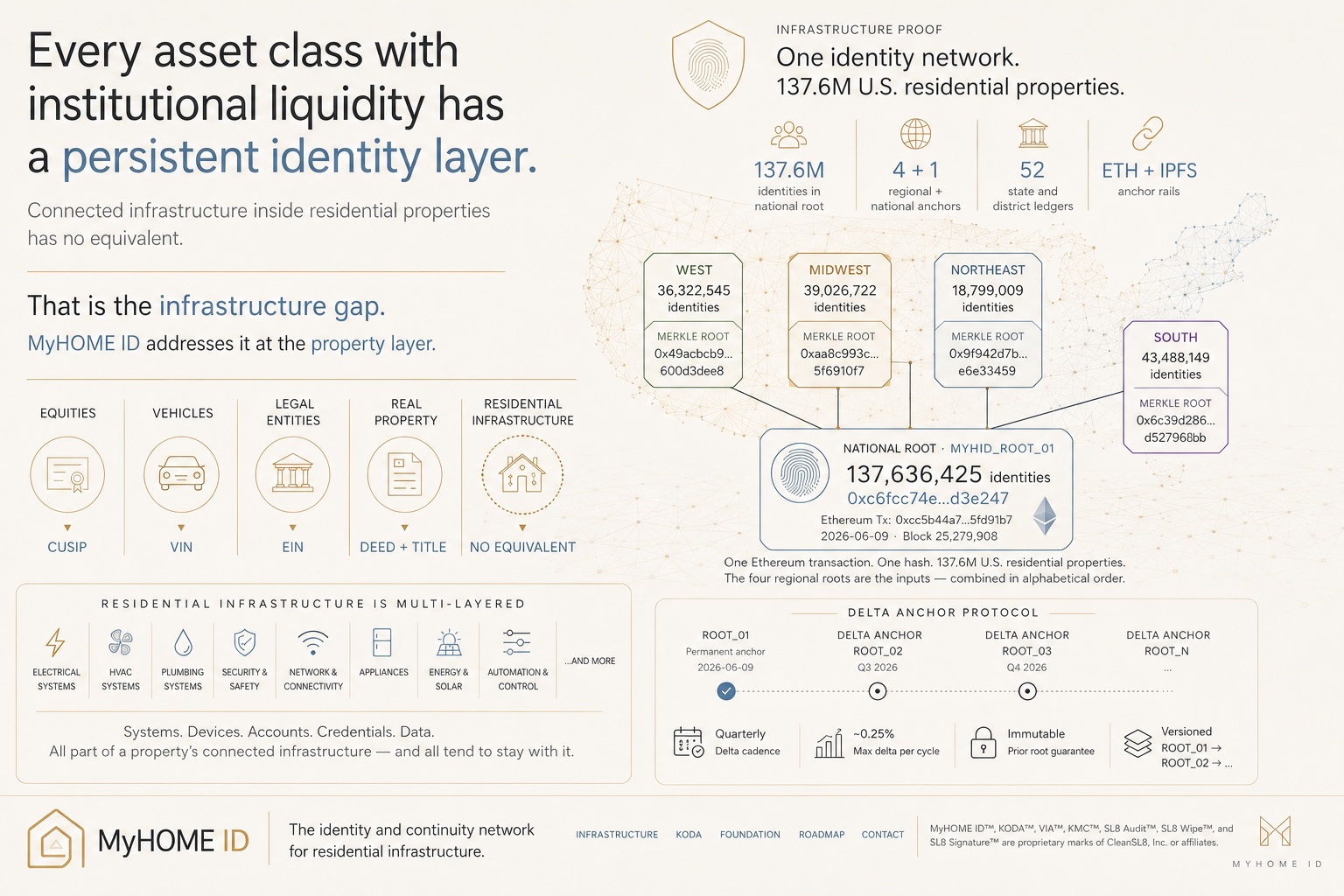
Regional Merkle Anchors

Ethereum and IPFS verification for MyHOME ID regional ledgers. Each region exposes a point-in-time ledger manifest, state-level Merkle roots, and cryptographic file hashes for long-term infrastructure continuity.

138M+
Regional Identities
Represented
4
Regional Manifests
Released
52
State & District
Ledgers
ETH + IPFS
Anchor Rails
A Single Fingerprint for a Regional Ledger

A Merkle root is a single cryptographic fingerprint that summarizes every record in a regional ledger. If even one byte changes — one address or one identifier — the fingerprint changes. The roots below are immutable. They prove the ledger that existed at the timestamp shown is the same ledger being referenced now.

Regional Manifest
Northeast
18,799,009 identities
ETH 0x1b9c33f7…aa9951a3 Feb 24 2026 · 13:17 UTC
Published Merkle 0x9f942d7b…e6e33459
Manifest Root 0x9f942d7b…e6e33459
Regional Manifest
West
36,322,545 identities
ETH 0x41870f1a…201a755e Mar 9 2026 · 06:05 UTC
Published Merkle 0x35431cf8…634e879e
Manifest Root 0x49acbcb9…60d3dee8
Regional Manifest
Midwest
39,026,722 identities
ETH 0xdcc19010…b20e80df Mar 9 2026 · 06:10 UTC
Published Merkle 0x10f99d43…46a1edb7
Manifest Root 0xaa8c993c…5f6910f7
Regional Manifest
South
43,488,149 identities
ETH 0x7567e0ea…8aadc14a Mar 9 2026 · 06:19 UTC
Published Merkle 0xba972a69…4e60d30e
Manifest Root 0x6c39d286…d527968b

Every regional root resolves into state ledgers.

Northeast 9 files
ct.jsonl.gz ma.jsonl.gz me.jsonl.gz nh.jsonl.gz nj.jsonl.gz ny.jsonl.gz pa.jsonl.gz ri.jsonl.gz vt.jsonl.gz
West 13 files
ak.jsonl.gz az.jsonl.gz ca.jsonl.gz co.jsonl.gz hi.jsonl.gz id.jsonl.gz mt.jsonl.gz nm.jsonl.gz nv.jsonl.gz or.jsonl.gz ut.jsonl.gz wa.jsonl.gz wy.jsonl.gz
Midwest 13 files
ia.jsonl.gz il.jsonl.gz in.jsonl.gz ks.jsonl.gz md.jsonl.gz mi.jsonl.gz mn.jsonl.gz mo.jsonl.gz nd.jsonl.gz ne.jsonl.gz oh.jsonl.gz sd.jsonl.gz wi.jsonl.gz
South 17 files
al.jsonl.gz ar.jsonl.gz dc.jsonl.gz de.jsonl.gz fl.jsonl.gz ga.jsonl.gz ky.jsonl.gz la.jsonl.gz md.jsonl.gz ms.jsonl.gz nc.jsonl.gz ok.jsonl.gz sc.jsonl.gz tn.jsonl.gz tx.jsonl.gz va.jsonl.gz wv.jsonl.gz

Every stakeholder.
One reference point.

Without a shared identity layer, every institution integrates bilaterally with every other. MyHOME ID collapses that to one integration each.

Title & Closing

The homes you're insuring have changed. The title report hasn't.

Today's closing may involve 20+ connected fixtures, three integrated security systems, and a solar array tied to an app. MyHOME ID is the layer that changes what a title report contains.

MLS Systems

Smart Device Fixtures are property features. They should appear in every listing.

There is no verified field for them in any MLS. MyHOME ID gives MLS systems the SDF documentation standard they've been missing.

Insurance Carriers

A verified technology profile is a better-understood risk.

Verified digital infrastructure documentation reduces ambiguity in property risk assessment. Better pricing. Better underwriting. Less uncertainty.

Builders & Developers

Every new home you build can be delivered with a complete verified profile.

MyHOME ID instantiation is available at the property layer before first occupancy. Certification at delivery becomes a differentiator.

"The identity exists before the scan.
Not derived from it. Not generated by it.
Already there."
MyHOME ID · CleanSL8 Inc. · Pittsburgh, PA